
Weber & Leucht GmbH
Booth number: 1015
weber-leucht.com
About us
The Weber & Leucht Application Lab is an international development center and laboratory. As well as a number of services in the fields of textile engineering, sustainability, ecodesign, consulting, process optimization and certification, our portfolio also includes important standard services such as quality assurance and damage claim analytics.

Address
Am Roehlingsberg 20
36043 Fulda
Germany
E-mail: thomas.leucht@weber-leucht.com
Phone: +49 661 3805672
Internet: weber-leucht.com
Avenida Colinas del Cimatario, Número 435
Planta Baja Int.1-B, Colinas del Cimatario
C.P. 76090 Querétaro
Mexico
E-mail: lab@weber-leucht.com
Phone: +49 661 3805672
Internet: weber-leucht.com
Contact person:
Thomas Leucht
E-mail: thomas.leucht@weber-leucht.com
Products & Services
TESTING LABORATORY
Our testing laboratory supports our customers in testing the fitness for use, safety and reliability of their products.
We not only prepare the corresponding reports but also provide clearly comprehensible interpretations of results, thus combining testing and consultancy services. As independent experts, we develop specifications and offer acceptance testing for tender processes.
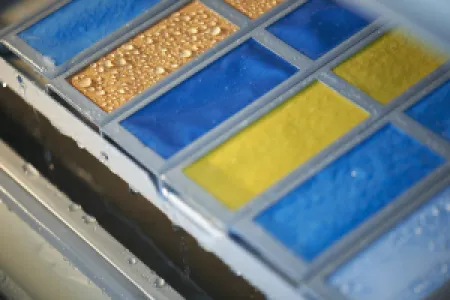
Testing "Durability and Sustainability"
Weber & Leucht offers you a holistic advice and support under the aspects of sustainability and circular economy - along the production processes. Would you like assistance with regard to the requirements profile of your product, meaningful performance tests or benchmarking of your developments? Whether durability, microplastic emission, performance: we support you in verifying your claim.
Use our possibilities to create a "Product Passport" as a comprehensive quality concept!
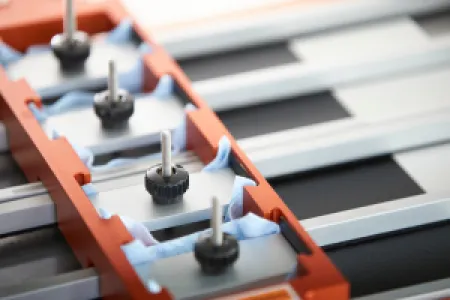
Testing Microplastics, MLC Index & Ecodesign
ind out about our testing and assessment methods for microplastics: We present our experience from six years of intensive international project work and introduce the tool developed from it for assessing and optimizing raw materials and end products.
How can a seemingly invisible abrasion be qualitatively and quantitatively recorded - and how can the findings and the resulting added value be certified?
Based on standardized methods, our MLC assessment enables the exact classification of a test sample with regard to its expected microplastic release during its life cycle. Thus, our MLC assessment forms an essential part of product-specific ecodesign.
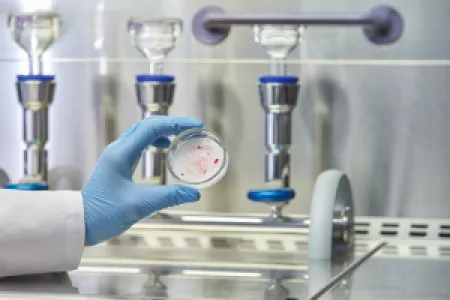
TEX-QMS
Our TEX-QMS is a textile quality management system that perfectly supports production and service companies whenever textiles are used. The system was introduced to the US market by Weber & Leucht in 2016 and has its conceptual roots in the USA. TEX-QMS includes all the steps required for seamless quality assurance in the textile sector. As an accredited testing laboratory, we offer you a unique complete service that combines all important individual services: A status quo analysis, the creation of specifications, the continuous control of purchased textile materials, the archiving of reserve samples and the processing of any damage claims.
TEX-QMS was specially developed for the requirements of the textile industry and is particularly aimed at:
manufacturers of textile products or products with textile components
designers who use textile materials
manufacturers of medical products and personal protective equipment
raw material suppliers of fibres, textile auxiliaries and composite materials
service providers who use textile products, such as the hotel and catering industry, laundries, building cleaners, wellness and rehabilitation facilities
traders and importers of textile products of all kinds
You can join our quality system during an existing project or at the beginning of a new one - or with a current claim. An essential basis of TEX-QMS is the comparison of all samples with Weber & Leucht's own database ("BASE"), in which the "fingerprints" of tens of thousands of textile and textile chemical raw materials are stored.
Colourimetry
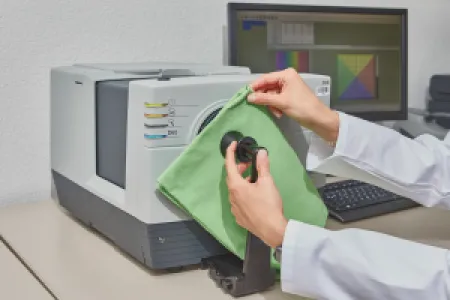
mmerse yourself with us in the world of colourimetry with all its specifications, requirement profiles, standards and various influencing factors. Based on international standards, our colour measuring instruments provide clear values in the form of numerical results for a wide range of applications.
Coloured or white samples can be compared with a defined reference sample. In principle, every colour can be described exactly, a remission curve can be created for every object, and even the smallest deviation can be found and documented.
Our test reports thus verify unwanted deviations that may be relevant in the context of quality assurance.